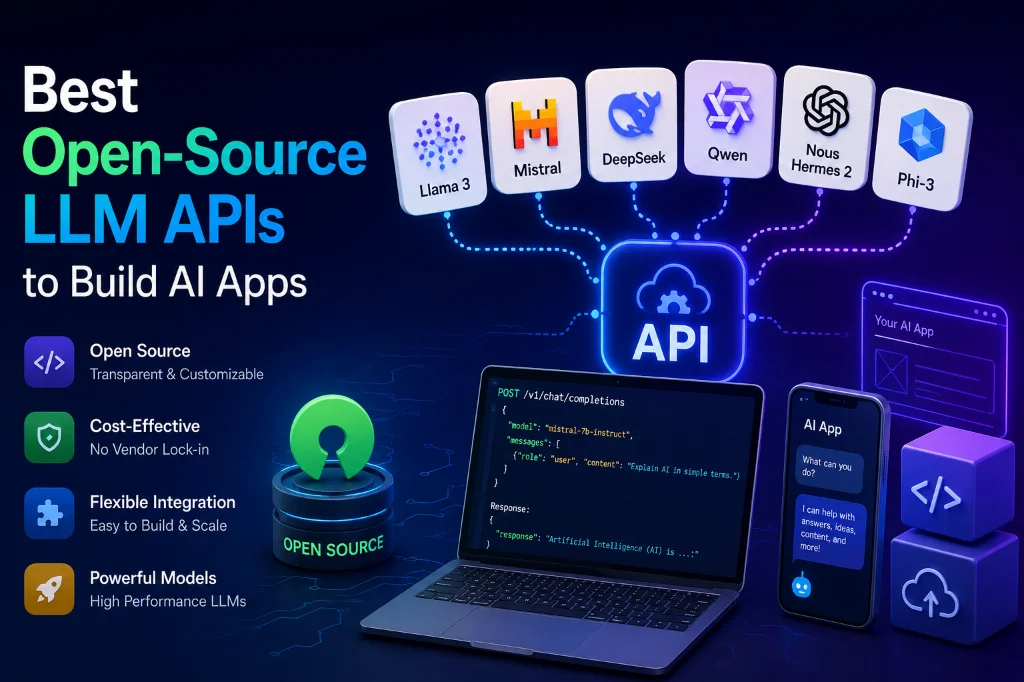
Building an AI application no longer requires a direct line to OpenAI's billing department. By mid-2026, developers are increasingly switching to the best open-source LLM APIs because they offer performance comparable to GPT-4o at a fraction of the cost, with the added benefit of avoiding vendor lock-in.
The Shift Toward Open-Weight Inference
The developer environment has undergone a massive shift. In previous years, choosing an open-source model meant sacrificing quality for the sake of privacy. However, according to a 2026 report by Lush Binary, six major labs now ship open-weight models like Llama 4, Qwen 3.6, and GLM-5.1 that match or exceed proprietary alternatives on key benchmarks like SWE-bench Pro.
This parity means the real differentiator is no longer just the model itself, but the API infrastructure supporting it. Modern developers need APIs that handle the heavy lifting of GPU orchestration, offer low-latency inference, and provide OpenAI-compatible endpoints so you can swap models in tools like Cursor or Bolt.new with a single line of code. A 2026 analysis from GlyphSignal indicates that open-source hosts offer inference that is 3 to 10 times cheaper than proprietary counterparts for high-volume tasks.
Top 7 Best Open-Source LLM APIs for Developers
1. Groq (Fastest Inference)
Groq remains the speed leader in the open-source API market. By using Language Processing Units (LPUs) rather than traditional GPUs, Groq delivers models like Llama 3.3 and Mixtral at speeds exceeding 500 tokens per second. For developers building real-time applications like voice assistants or high-speed chat interfaces, Groq is the gold standard. Their API is fully compatible with the OpenAI SDK, making it an easy drop-in replacement for ChatGPT in your backend.
2. Together AI (Best Model Variety)
Together AI provides one of the most diverse libraries of open-source models. From Meta’s Llama series to Mistral and specialized coding models, Together allows developers to experiment with fine-tuned versions of popular architectures. Their serverless inference is highly reliable, and they offer a "Turbo" version of many models that optimizes for both cost and speed. It is a top choice for startups that need to scale from prototype to production without managing their own clusters.
3. SiliconFlow (Best for Individual Developers)
As highlighted in recent 2026 developer guides, SiliconFlow has become a favorite for individual developers due to its generous free tier and stable access to flagship models like DeepSeek and Qwen. It solves the common "billing anxiety" associated with testing new features. If you are building a small tool or a demo, SiliconFlow provides a stable environment without the regional access restrictions often found with US-based providers.
4. Fireworks AI (Best for Low Latency)
Fireworks AI focuses on high-performance inference through optimized machine learning kernels. They are particularly known for their "FireFunction" models, which are open-source models fine-tuned specifically for function calling and tool use. This makes them ideal for developers using Replit AI to build agentic workflows where the model needs to interact with external databases or APIs accurately.
5. OpenRouter (Best Unified Interface)
OpenRouter functions as an aggregator, providing a single API key to access almost every open-source and proprietary model on the market. It automatically routes your requests to the provider with the lowest price or highest uptime. For developers who want to avoid managing multiple API keys and billing accounts, OpenRouter simplifies the stack significantly. It is the most flexible way to compare how different models perform on the same prompt in real-time.
6. Hugging Face Inference Endpoints
If you need to deploy a specific, niche model from the Hugging Face hub that isn't hosted by general providers, Inference Endpoints is the solution. This service allows you to spin up dedicated infrastructure for any of the hundreds of thousands of models available on the platform. While it requires more configuration than a serverless API, it offers total control over the hardware and environment, which is vital for enterprise security and compliance.
7. DeepInfra
DeepInfra offers a no-frills, highly scalable API for the most popular open-source models. They are known for their aggressive pricing and simple integration. They provide excellent support for image generation models alongside LLMs, making them a strong candidate if your app requires multi-modal capabilities like generating text and images within the same workflow.
Comparison of Open-Source API Providers
| Provider | Best For | Key Advantage |
|---|---|---|
| Groq | Real-time Apps | Unmatched token-per-second speed |
| Together AI | Production Scaling | Huge model library and reliable uptime |
| SiliconFlow | Free Tier/Individuals | Excellent access to Qwen and DeepSeek |
| OpenRouter | Flexibility | Unified API for all open-source models |
| Fireworks AI | Function Calling | Optimized for agentic workflows |
Who Should Use This / Our Recommendation
If you are building a high-speed consumer application where latency is the primary concern, Groq is the clear choice. For developers who need the broadest range of models and a path to fine-tuning, Together AI offers the most professional ecosystem. If you are a solo developer looking to experiment without upfront costs, start with SiliconFlow or OpenRouter to find the model that fits your specific use case before scaling up.
Frequently Asked Questions
Q: Are open-source LLM APIs really as good as OpenAI?
In 2026, the gap has largely closed for most common tasks like summarization, coding, and logical reasoning. While proprietary models might still hold a slight edge in very complex, multi-step reasoning, open-source models like Llama 4 and Qwen 3.6 are more than sufficient for 95% of commercial applications.
Q: Can I use these APIs for commercial applications?
Yes, most providers host models under permissive licenses like Apache 2.0 or the Llama Community License, which allow for commercial use. However, always check the specific license of the model you choose, as some may have restrictions based on the number of monthly active users.
Q: How do these APIs handle data privacy?
Most API providers offer SOC2 compliance and guarantee that your data is not used to train their base models. For maximum privacy, Hugging Face Inference Endpoints allow you to deploy models in private VPCs, ensuring your data never leaves your controlled environment.
The best way to future-proof your AI application is to build with a provider-agnostic approach, allowing you to switch between these top-tier open-source APIs as prices and performance evolve.
Last updated: May 2026. Tool features and pricing are subject to change — verify on official websites before deciding.